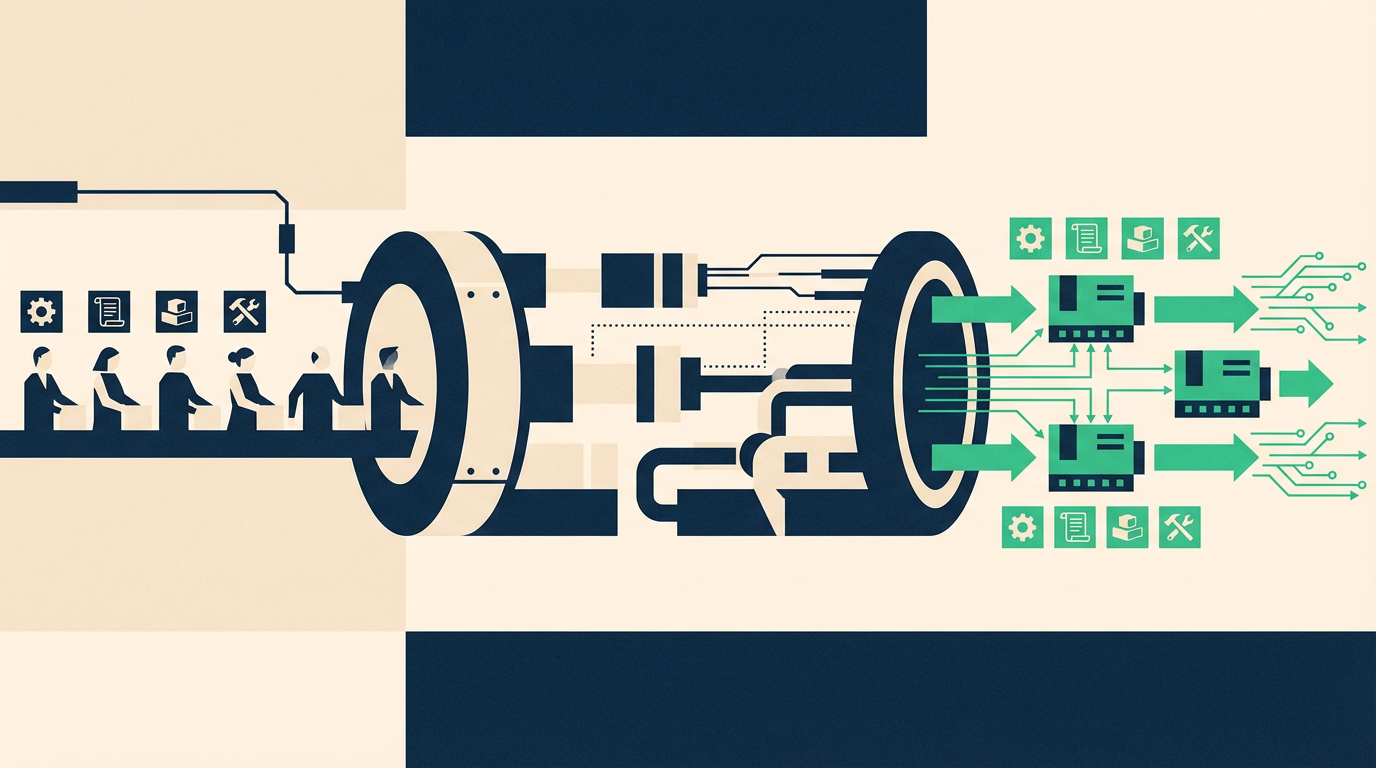
Why the operating ratio drifts.
A B2B business between £5m and £25m in revenue can usually scale by hiring. Each new sales rep produces predictable revenue. Each new account manager covers a predictable book. Each new marketing hire produces a predictable unit of output. The linear relationship between headcount and revenue is what powers the first scale phase.
Somewhere between £20m and £40m, the linear relationship starts to decay. New sales reps take longer to productivity. Each new account manager adds less incremental revenue per head. The marketing team grows but output per head falls. The finance director notices the ratio of revenue per employee moving the wrong way. The board begins to ask about operating leverage.
The usual response is one of three things. Hire better (which is expensive and slow). Restructure (which is disruptive and distracts from the business). Cut headcount (which signals contraction and damages the commercial machine). None of them address the root cause, which is that a meaningful portion of what the people in the business are doing is rote work that no longer requires a person to do it.
In 2026, a significant share of commercial-edge work can be handled by automation and AI agents at a quality and reliability level that would have been impossible eighteen months ago. The businesses that are using this moment to automate rather than to hire are the ones whose operating ratio is moving the right way. The businesses still hiring through the bottleneck are the ones where the ratio continues to decay.
What the rote work actually is.
The phrase "automate the commercial edge" is abstract until you name the work. In a typical £30m B2B business we look at, the automatable commercial work falls into five buckets.
Bucket one. Marketing production and distribution.
Briefing content writers. Formatting posts for LinkedIn. Scheduling publication. Reformatting case studies for different channels. Uploading to the CMS. Tagging and categorising. Producing monthly reports. Managing the content calendar across multiple stakeholders. In most businesses, this represents 1.0 to 1.5 FTE of marketing time that is production admin rather than strategy.
Bucket two. Inbound lead qualification and routing.
Reading inbound enquiries. Researching the company. Assessing fit against an ideal customer profile. Routing to the right sales rep. Logging in the CRM. Following up on unresponsive enquiries. Scoring leads. Tagging by campaign source. This is typically 0.5 to 1.0 FTE of sales ops or SDR time.
Bucket three. First touch sales outreach and discovery.
Initial outreach emails. Chase sequences. Discovery call scheduling. Pre-call research. Post-call follow up. CRM hygiene after each call. This is typically 0.5 to 1.5 FTE of sales time that does not actually involve the high-value human conversation.
Bucket four. Account management and renewal workflows.
Usage data aggregation. Customer health scoring. Renewal reminder workflow. Quarterly business review preparation. Account expansion opportunity identification. Churn signal monitoring. In a £30m business this is often distributed across 2.0 to 3.0 FTE of account management time.
Bucket five. Tier one customer support.
First response to inbound support queries. Triage and routing. Knowledge base lookup. Standard answer delivery for common questions. Ticket tagging and escalation. This is typically 1.0 to 2.0 FTE of customer support time.
Added together, in a typical £30m business, these five buckets account for somewhere between 5.0 and 9.0 FTE of effort. At average loaded costs for the UK in 2026, that is £300k to £540k of annual cost. Most of it is doing rote work that, with proper design, an automated system can handle with higher consistency and lower error rate than a human.
The question is not whether to automate. It is which order to automate in.
The sequence that actually works.
We have seen this done well and badly. The single biggest predictor of success is sequencing. Automation done in the wrong order creates more mess than it solves. Automation done in the right order compounds.
The sequence below is the one we recommend for most businesses. It assumes you are starting with a Fortitude Media subscription in place and are building out the automation workstreams sequentially over eighteen to thirty months.
-
Months 0 to 12. Subscription foundation.
Website, content engine, PR, authority building, AI visibility reporting. This is the front end. It establishes brand discipline, content architecture and reporting infrastructure that every subsequent automation depends on. Part of the Fortitude Media subscription. -
Months 6 to 18. Marketing production automation.
Content briefing, formatting, distribution, reporting. This is the easiest bucket to automate and the one with the fastest payback. Scoped as a separate engagement once the subscription foundation is in place. -
Months 9 to 21. Inbound qualification automation.
Lead enrichment, scoring, routing, CRM hygiene. This is the second easiest bucket and the one that shows up fastest in sales team capacity. Scoped separately. -
Months 12 to 24. First touch sales automation.
Sequencing, meeting scheduling, research prep, post-call follow up. This is where the heavier lift begins. Requires careful integration with the CRM and the sales team's workflow. Scoped separately. -
Months 18 to 30. Account management automation.
Health scoring, renewal workflow, expansion identification. This is the highest leverage bucket and also the one with the most sensitivity, because it touches customer relationships. Scoped separately. -
Months 24 to 36. Customer support AI.
Tier one handling, ticket routing, knowledge base authoring. Usually the last bucket because it requires robust knowledge architecture to handle well. Scoped separately.
Not every business runs all six workstreams. Most clients commission two or three, depending on where their specific bottleneck is. The audit identifies the right starting point.
Why David Adams leads this specifically.
The automation programme is not a secondary product we added to make the subscription sound more impressive. It is the discipline David Adams, co-founder, has built his career on.
David spent thirteen years inside B2B technology and subscription platforms, from retention representative to COO, across two C-suite roles as both COO and Chief Revenue Officer. He managed more than $30m in annual B2B partner revenue across 1,500 relationships globally. He built an advertising network from zero to over £2m in twelve months. At Lucennio, his current consultancy, the focus is specifically on GTM automation and AI powered sales systems for B2B teams.
The tools he builds with are the ones that matter in 2026 B2B automation. HubSpot, Salesforce, Clay, Apollo, Make, n8n, Zapier, OpenAI and Anthropic APIs, Google Ads, Meta Ads, LinkedIn Ads, GA4, Looker Studio, BigQuery, Airtable, Notion, Slack Workflows. Every automation workstream we scope is built on this stack, which means the systems we build are maintainable by any competent RevOps team in the market, not locked to us as a vendor.
This matters because the operating leverage argument depends on the automation being defensible after we step back. A business that installs proprietary automation that only we can maintain has simply moved the supplier dependency, not solved it. The Fortitude Media approach is built on standard tooling, properly documented, with your team trained on it. That is what makes the operating leverage real rather than theoretical.
How the two relate commercially.
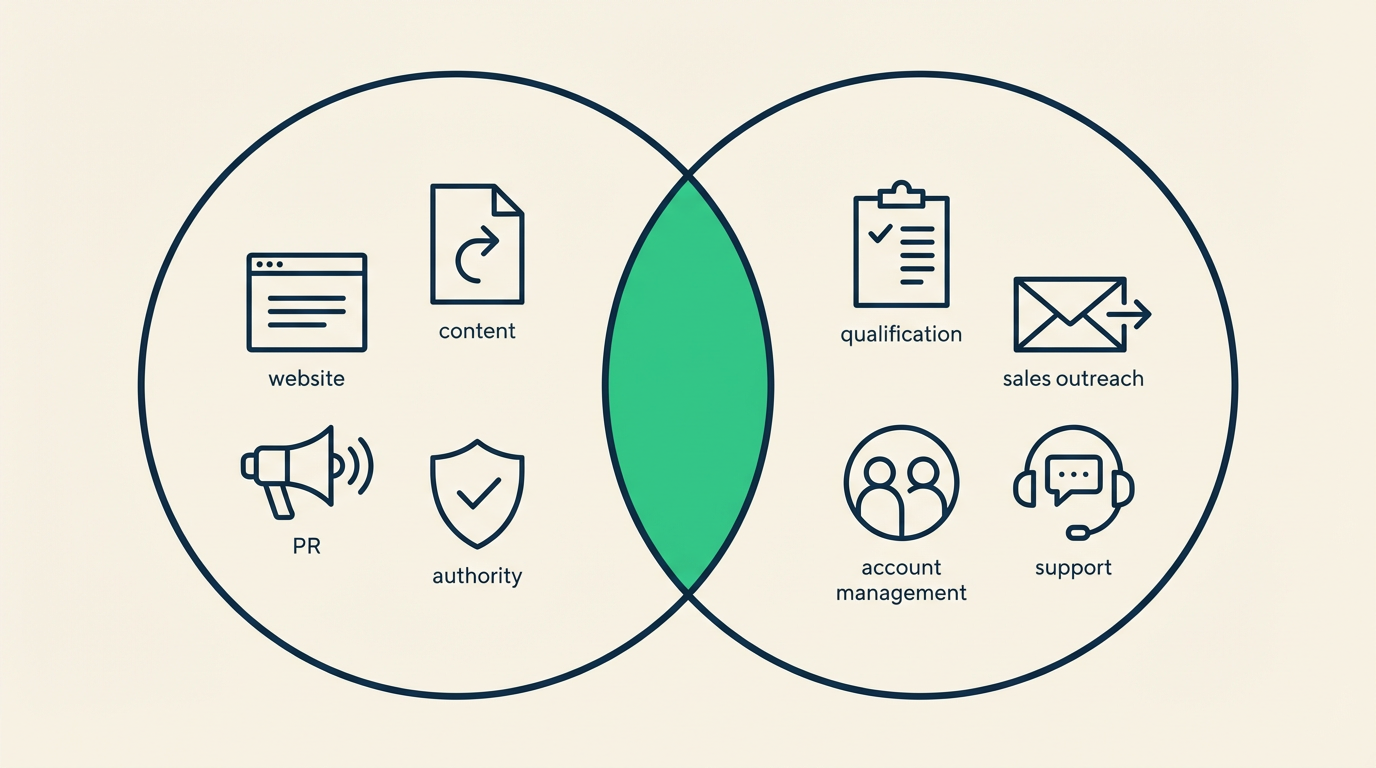
The Fortitude Media subscription and the automation programme are commercially separate but operationally interlocked.
The subscription is a fixed monthly fee covering the website, content, PR, authority building and AI visibility reporting. The automation workstreams are scoped individually, priced per engagement, and run in parallel with the subscription rather than as part of it.
The reason they are priced separately is clarity. The subscription needs to be simple to understand and easy to defend on a board pack. Each automation workstream has its own scope, its own timeline and its own success metric, which needs to be commercially visible rather than hidden inside a subscription fee.
The reason they are operationally interlocked is that the content, data and reporting produced by the subscription is what the automation workstreams operate on. Marketing production automation automates the production of content we are already creating. Inbound qualification automates the handling of leads that are arriving because of the AI visibility work. The two sides compound each other. Running either one alone produces a fraction of the impact.
Start with the audit.
If operating leverage is the lens you are using, the audit identifies the specific bucket where automation will have the fastest impact in your business. Five working days. No obligation.
Frequently asked questions.
How much does the automation programme cost?
Each workstream is scoped individually. Typical ranges: marketing production automation £40k to £80k implementation plus a small monthly retainer. Inbound qualification automation £30k to £60k plus retainer. First touch sales automation £60k to £120k plus retainer. Account management automation £80k to £160k plus retainer. Customer support AI £100k to £200k plus retainer. Specific pricing comes out of scoping sessions once you have the subscription foundation in place.
Can we use your automation programme without the subscription?
Technically yes, commercially we recommend against it. The automation works better when the content, data and reporting infrastructure from the subscription is in place. Clients who take the automation without the subscription usually find they need to rebuild some of the subscription deliverables inside the automation workstream, which ends up more expensive.
How defensible is the automation after you step back?
Highly. We build on standard tooling (HubSpot, Salesforce, Clay, Make, n8n, OpenAI and Anthropic APIs) that is maintainable by any competent RevOps professional in the market. We document everything. We train your team. After handover, you are not dependent on us to keep the automation running. If you want us to continue maintaining it, we offer maintenance retainers. If you do not, the systems run independently.
What FTE impact should we realistically expect?
For a £30m business running three or four of the workstreams over twenty four months, a typical outcome is 3.0 to 5.0 FTE of rote work absorbed by automation. That rarely translates directly into redundancies. Most clients redeploy those people into higher value work (more sales conversations, more account management depth, more marketing strategy). The commercial impact shows up as revenue per employee rather than as headcount reduction.
How does this interact with our existing RevOps team or consultancy?
Well, usually. If you have an existing RevOps function, we work with them rather than around them. Most existing RevOps teams welcome the additional capacity and the external perspective. If you are working with an external RevOps consultancy, we will scope around their work. We are not looking to replace your existing team. We are looking to accelerate what they are already doing.
When is this premature?
If your business is under £10m in revenue, the automation programme is probably premature. At that scale, the operating leverage gain is smaller than the implementation cost, and simple tool choices (a well configured HubSpot, a decent SDR) usually produce better return than full automation. We are honest about this in the audit. Under £10m, we recommend the subscription only and a specific set of low cost tooling recommendations.
Related reading.
For the valuation CEO
Operating leverage is the single most valuable lever if you are preparing for sale.
Read moreFor the profitability CEO
If the priority is consolidating suppliers before automating work.
Read moreFor the growth CEO
If pipeline softness is the more urgent problem than operating efficiency.
Read moreFor the competitive pressure CEO
If a named competitor is already operating with automation in place.
Read more