
The specific thing changing in mid market valuations right now.
Three years ago a UK mid market B2B business with £10m to £50m in revenue could reasonably expect six to nine times adjusted EBITDA at sale, with the number driven by profit quality, customer concentration, sector tailwind and management depth. The variables on the scorecard were predictable and the buyer's diligence followed a familiar script.
That scorecard has shifted. In the last eighteen months the sophisticated mid market buyers, private equity sponsors and strategic acquirers alike, have added two new categories to the diligence pack. The first is AI readiness. The second is operating leverage. Businesses that score well on both have moved from nine times to eleven or twelve times in completed 2025 and early 2026 transactions. Businesses that score poorly have compressed by two to three turns, regardless of their historical profit trajectory.
This is not a theoretical argument. It is visible in completed deal data, in the questions now showing up on diligence checklists, and in the way buyers are framing their investment theses. If you are planning to sell in the next three to seven years, the work you do now on AI readiness and operating leverage will determine whether you land at the top of the range or the bottom.
The two levers that move the multiple.
There are many things that influence a mid market valuation. Most of them, customer concentration, revenue mix, growth rate, margin quality, are outside what Fortitude Media touches. Two of them are directly inside what we do, and both have become outsized drivers of the final number.
Lever one. AI readiness.
A buyer in 2026 is underwriting the business they will own in 2029. They are not paying you for how your marketing worked in 2024. They are paying you for the compound effect your current operating machinery will produce for the next three to five years under their ownership. That means the question is no longer "does the website rank on Google" but "is this business going to be visible when buyer behaviour finishes shifting to AI tools."
Concretely, the diligence now includes questions like these. What percentage of your organic discovery currently runs through AI answer engines versus traditional search. How often is your company cited in ChatGPT, Claude, Perplexity and Gemini against named competitors. Does your website technical architecture support AI citation (schema markup, llms.txt, structured content, authority signals). Is your content strategy producing citation weight or just page count. Is your PR footprint in the publications AI models weight most heavily, or in trade press nobody reads.
A business that can answer those questions with data earns a premium. A business that cannot answer them at all gets priced as if the new channel does not exist, which is the same as being priced on the old channel in a declining market. Both outcomes compress the multiple.
Lever two. Operating leverage.
Operating leverage, in the context of a sale, is the ratio of output you produce for each unit of input. A business generating £30m in revenue with 200 employees has lower operating leverage than one generating the same £30m with 120 employees and a functioning automation stack. Buyers pay more for the second one because the cost base is structurally lower and the commercial machine is more defensible.
In 2026 the operating leverage question has two sub-questions layered onto it. How much of your commercial edge, marketing, sales admin, qualification, account management, customer support, is handled by software and agents rather than people. And how ready is the remaining people-dependent work to be automated by the buyer post-acquisition. A business that has already done the hard thinking about what can be automated, and has put the infrastructure in place, is worth more than a business that has not.
This is the reason the Fortitude Media subscription leads with the website but does not end there. The website is the asset that earns trust in the data room. The automation programme that follows is the asset that demonstrates the leverage.
What a Fortitude Media engagement changes in the data room.
If you are three to seven years from sale, the Fortitude Media subscription starts with the website and the content engine. That is the foundation. It is also the first asset a buyer's advisors will inspect, because it tells them more about your commercial discipline than almost anything else.
Inside twelve months of subscription, a well executed engagement produces the following in the data room.
- A modern website with clean schema, structured data, llms.txt, and an architecture that AI models read and cite. Buyers can verify this themselves using any of the four major AI tools during diligence.
- Monthly AI visibility reports covering ChatGPT, Claude, Perplexity and Gemini, with citation rates on named buyer prompts over time, benchmarked against competitors. Board ready reporting, twelve months of trend data.
- A content archive that demonstrates topical authority in your sector. Minimum twenty four pillar and cluster pieces by month twelve, each one published, indexed and earning citations.
- PR placements in the trade and national publications AI models weight most heavily. Twelve to twenty four placements over twelve months, each one archived and evidenced.
- A live dashboard showing competitor citation rates, share of voice and gap analysis. This is the single most differentiated asset in the pack because most sellers have nothing comparable.
- A LinkedIn authority programme for the senior team that reduces key person risk by building out named expertise in the business beyond the founder.
Inside twenty four months, for clients who continue into the automation programme, the data room gains a second tier of evidence. GTM automation that handles inbound qualification. Sales AI that handles first touch. Account management automation that handles renewal workflows. Customer support AI that handles tier one contacts. Each workstream is scoped as a separate engagement once the subscription foundation is compounding. Together they produce the operating leverage score a 2026 buyer is looking for.
How the number moves. A worked example.
This is an illustrative model, not a client case. The multiples and figures are drawn from completed 2025 and early 2026 mid market UK B2B transactions and from published deal data. Your business will look different. The direction of travel will not.
Consider a B2B services business with £20m in revenue, £4m in adjusted EBITDA, planning to sell in year four. At the start of year one the business scores poorly on AI readiness (no citation presence, weak content engine, no AI visibility reporting) and has average operating leverage for its sector (ratio of revenue to headcount in the 25th percentile of peers).
In the base case, the business continues on its current trajectory. Modest growth. No significant operating leverage improvement. Standard marketing spend with the existing web agency, content retainer and PR freelancer. At sale in year four the business achieves £5.5m EBITDA and exits at 7.5 times, for an enterprise value of £41.25m.
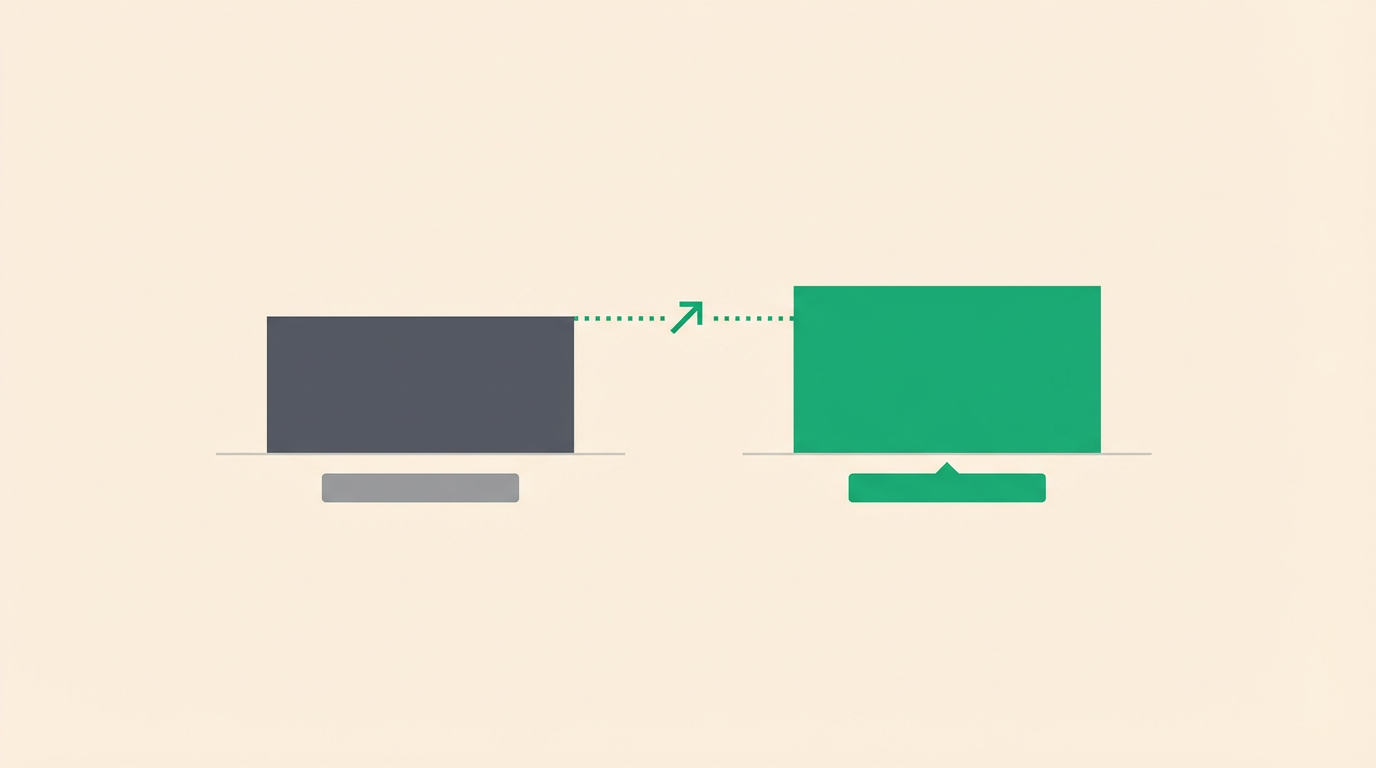
In the upgraded case, the business commissions a Fortitude Media subscription in year one (£36k annually), adds the GTM automation workstream in year two (£60k to £120k, scoped at that point), and adds customer support AI in year three. By year four, the business has £5.8m EBITDA (the automation programme adds modestly to profit but more significantly to quality), and exits at 10.5 times because the data room presents a verifiable AI readiness story and demonstrable operating leverage. Enterprise value at exit: £60.9m.
The difference is nearly £20m in enterprise value against a cumulative additional investment of approximately £250k to £350k over three years. Even accounting for the tax impact of a higher exit and the opportunity cost of the investment, the arithmetic is decisive. No other marketing investment in a £20m business has a comparable effect on enterprise value.
Why this is a subscription rather than a project.
Preparing a business for sale is not a single event. It is three to seven years of operating decisions that show up as a coherent story in the data room when the process starts. AI readiness especially compounds. Citation weight in ChatGPT today is worth more than citation weight in twelve months, because the models will have indexed and reinforced the signal over that time. You cannot reverse engineer that in the six months before you go to market.
The Fortitude Media subscription is designed to run for the full preparation window. Twelve months to establish the foundation. Twelve to twenty four months to build compound authority. Twelve months of continuous evidence production for the data room. A one-off project engagement produces none of the compounding, and a sale process that starts from zero AI readiness looks identical to competitors who are also starting from zero.
This is also the reason we do not sell the subscription on a minimum term. Founders who are preparing for sale are the most disciplined buyers of continuity we work with. They understand why continuity matters. They rarely cancel.
The longer arc. Website. Automation. Agents.
The subscription is the entry point. For founders on a three to seven year sale horizon, most engagements expand beyond the subscription into one or more adjacent workstreams over time. The sequence we recommend runs roughly as follows.
-
Months 0 to 12. Subscription foundation.
Website, content, PR, authority, AI visibility reporting. -
Months 6 to 18. GTM automation.
Inbound qualification, lead enrichment, first touch outreach, pipeline reporting. Scoped as a separate engagement. -
Months 12 to 24. Sales AI.
First touch discovery calls, qualification scoring, CRM hygiene, forecasting support. Scoped as a separate engagement. -
Months 18 to 30. Account management automation.
Renewal workflows, usage signals, health scoring, churn prediction. Scoped as a separate engagement. -
Months 24 to 36. Customer support AI.
Tier one handling, ticket routing, knowledge base authoring. Scoped as a separate engagement.
Each workstream is optional. Each is priced separately. None of them is a condition of the subscription. But each one, executed properly, adds a measurable unit of operating leverage to the business. For a founder three to seven years from sale, commissioning two or three of these workstreams across the preparation window is the most reliable way to move the multiple that we have observed.
David Adams, co-founder of Fortitude Media, leads the automation programme. His background (thirteen years inside B2B and subscription platforms, $30m annual partner revenue managed, two C-suite roles) is specifically why we can scope these workstreams credibly rather than hand waving about AI. The automation is not a sales pitch. It is a discipline.
Frequently asked questions.
How early in the sale preparation process should we start?
Earlier is better. Three years before your intended sale date is the practical minimum for AI readiness to compound into a visible data room story. Four to five years is comfortable. Seven years is generous. If you are inside eighteen months of sale, the subscription will still add value, but the upside will be smaller and the argument in the data room will be weaker. For founders inside twelve months of sale, we often recommend a targeted engagement rather than a full subscription.
Which buyer types care about AI readiness specifically?
Private equity sponsors with technology or tech-enabled services strategies care the most, because AI readiness is central to their post-acquisition value creation thesis. Strategic acquirers in technology, SaaS, professional services, financial services and media care next. Trade buyers in traditional sectors care less on AI readiness specifically but still care on operating leverage. If your most likely buyer is a PE sponsor, AI readiness is the single most leveraged thing you can work on before sale.
Will my existing marketing team see Fortitude Media as a replacement?
Fortitude Media replaces four of your marketing team's suppliers, not your marketing team. The web agency, the content retainer, the PR freelancer, the SEO consultant. A well scoped engagement is usually welcomed by the marketing director once they understand that it removes four vendor relationships from their plate and consolidates the reporting. For founders preparing to sell, we recommend including your marketing lead in the first conversation. It shortens the decision cycle and de-risks the rollout.
What does the data room actually look like at the end of twelve months?
The audit output, updated monthly. The AI visibility reports. The content archive with citation evidence. The PR placement log. The LinkedIn authority programme metrics. The competitor citation benchmarking. The schema and technical readiness evidence. If you have commissioned the automation programme, the workstream documentation and automation evidence sits alongside. We can show you a template data room structure at the audit stage if useful.
How does this interact with buy-side and sell-side advisors?
Well. Sell-side advisors (corporate finance boutiques, investment banks, M&A advisors) increasingly ask about AI readiness because they see it in diligence packs. A seller with a clean, evidenced story on AI and operating leverage is easier for them to market. Buy-side advisors doing diligence are the ones asking the questions in the first place. If you want, we can brief your chosen advisor directly when you engage one, and share the Fortitude Media output in a format their analysts can use.
How much does this actually cost over three years?
The Fortitude Media Professional subscription is £35,988 per year, £107,964 over three years. If you commission the GTM automation workstream in year two and the sales AI workstream in year three, the total three year investment is typically in the £220k to £340k range depending on scope. Against a £20m revenue business that is the difference between a seven times and a ten times exit, it is the cheapest single line item in the preparation programme.
Related reading.
For the growth CEO
If pipeline growth is the more urgent problem than sale preparation.
Read moreFor the profitability CEO
If consolidating the marketing stack comes before valuation planning.
Read moreFor the operating leverage CEO
If the priority is automating the commercial edge rather than preparing for sale.
Read moreFor the competitive pressure CEO
If a competitor is already getting cited by AI and the gap needs closing fast.
Read more